Origin Of Carbonate Sedimentary Rocks Pdf Extra Quality ((exclusive))
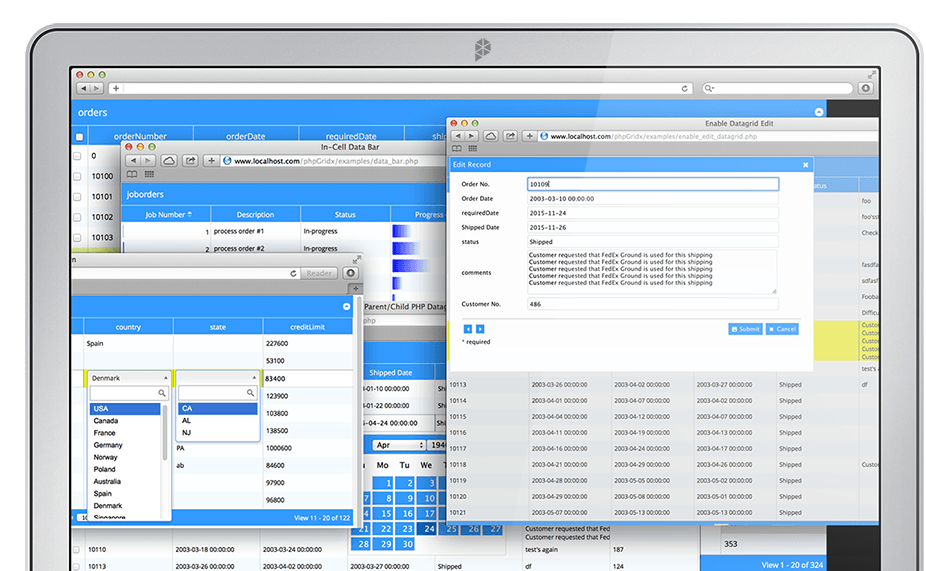
Generate fully customizable PHP CRUD in LESS THAN 5 MINUTES.
Generate fully customizable PHP CRUD in LESS THAN 5 MINUTES.



Auto-generate SQL statement for CRUD operations on the fly and are completely transparent to the users
By applying conditional formatting to a datagrid cell or row, you can quickly identify variances in a range of values with a quick glance.
A wealth of features including CRUD, WYSIWYG, file upload, autocomplete, composite primary key, and complete export capabilities.
With just one simple function call, you will have an interactive master detail data grid or subgrid.
Creating CRUD manually is time consuming and overwhelming. phpGrid was founded around a simple idea: generating beautiful and editable customized CRUD quickly.
All it takes to make a Perfect CRUD is only 2 LINES OF CODE.
You can enable edit by simply calling enable_edit(). phpGrid supports two types of edit modes, FORM and INLINE.






We think you’ll agree that’s quite impressive for such a minimal amount of code…absolutely minimal coding! phpGrid is the only PHP control that can create jQuery grid without Javascript.

I have come to love and depend on phpGrid for customer web applications, internal administration web apps, and reports and research tools for our many databases. It drastically cuts development time... I couldn't imagine not having phpGrid in our toolbox.

This CRUD tool set allows us to bring information to market faster, and enhances our value to the organization.







Shallow platforms protected from open-ocean waves by a continuous reef or ooid shoal barrier along the shelf edge.
. LMC is thermodynamically stable under atmospheric conditions and forms the structural basis of many ancient Paleozoic limestone records. Contains between 4% and over 20% MgCO3MgCO sub 3
Modern carbonate sediments are composed almost entirely of metastable (a different crystal form of CaCO₃) and magnesium-rich calcite , both of which readily recrystallize during diagenesis to form calcite. Other calcite group minerals such as magnesite (MgCO₃), rhodochrosite (MnCO₃), and siderite (FeCO₃) occur in limited amounts in restricted environments.
Geologists classify carbonate rocks using two primary descriptive systems, both emphasizing depositional texture and constituent particles. Dunham Classification System (1962) origin of carbonate sedimentary rocks pdf extra quality
Robert Folk’s system focuses on the relative proportions of three primary components: allochems (discrete grains), micrite (microcrystalline carbonate mud), and sparite (crystalline cement). Matrix-Dominated ( Bioclasts Biomicrite Biomicrite / Biosparite Biosparite Pellets Pelmicrite Pelmicrite / Pelsparite Pelsparite Intraclasts Intramicrite Intramicrite / Intrasparite Intrasparite
Precipitated calcium carbonate that fills pore spaces. 2. Depositional Environments and Formation
. The magnesium ions substitute into the calcite lattice, distorting the crystal structure and increasing its solubility relative to LMC. Secular Variations: Calcite vs. Aragonite Seas Shallow platforms protected from open-ocean waves by a
Controls both biological metabolic rates and the chemical solubility of CaCO3cap C a cap C cap O sub 3
The origin of carbonate sedimentary rocks is a story that spans from the microscopic precipitation of individual carbonate crystals to the grand architecture of ancient carbonate platforms. It is a story written in the shells of countless organisms, the chemistry of ancient oceans, and the slow, patient work of diagenesis over geologic time.
Unlike siliciclastic sediments derived from continental weathering, most carbonate sediments are produced in situ within the depositional basin through biological or chemical pathways. Contains between 4% and over 20% MgCO3MgCO sub
Tucker, M. E. (2001). Sedimentary Petrology: An Introduction to the Origin of Sedimentary Rocks. Blackwell Science.
The upper boundary where dissolution begins to accelerate due to low temperatures, high hydrostatic pressure, and elevated dissolved CO2CO sub 2
Geologists classify carbonate production zones into three primary factory types:
One of the most debated topics in sedimentary geology is the "Dolomite Problem." While dolomite is abundant in Paleozoic and Mesozoic strata, it is incredibly rare in modern marine sediments. Direct precipitation is kinetically inhibited at surface temperatures because water molecules tightly hydrate Mg2+cap M g raised to the 2 plus power
Spherical grains displaying concentric or radial cortical layers around a nucleus, formed by wave action. Bioclasts: Fossil skeletal fragments.